Denmark wants to give you copyright to your own face. Here’s where the Nordic rules actually stand.
The deepfake bill made global headlines. It still isn’t law — but a Nordic marketer publishing AI imagery is already regulated three times over.
When Denmark’s culture ministry announced that every citizen should own the rights to their own body, face and voice, the story travelled far beyond Copenhagen — “copyright to your own face” is an irresistible headline. A year on, the picture is more instructive than the headline: the bill is still not law, Europe’s lobbyists have pushed back, and meanwhile the rules that actually bind a Nordic marketing team publishing AI imagery today come from older, quieter places. Here is the real map.
What the Danish bill actually says
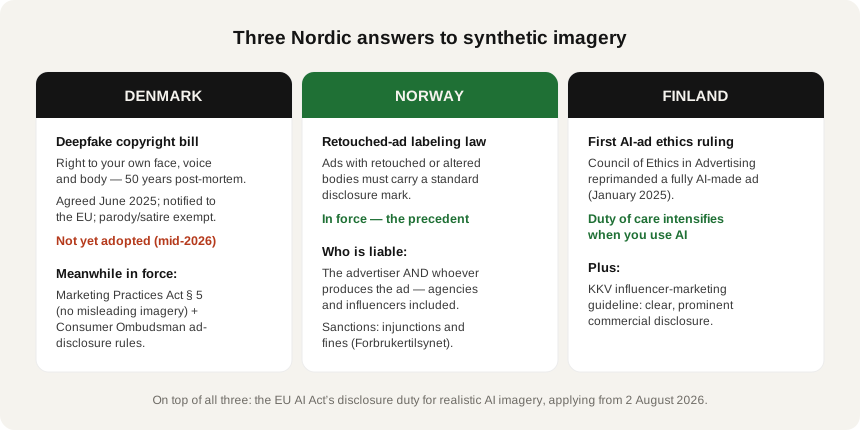
On 26 June 2025, the government and six other parties announced a broad political agreement protecting everyone’s right to their own body, facial features and voice against deepfake sharing. The draft amendment to the Copyright Act went into public consultation on 7 July 2025 and creates two new rights: a general protection for all natural persons (a new section 73 a) and a performance protection for artists (section 65 a). The mechanism is civil, not criminal: takedown, injunctions, damages and compensation, with the personal right lasting up to 50 years after death.
The exemptions matter for creative work: per Plesner’s analysis of the draft, caricature, satire, parody, pastiche and social criticism stay lawful — unless the imitation amounts to misinformation posing a serious risk to others’ rights or interests. Law firm Schjødt describes the design as notice-and-takedown plus compensation without needing to prove reputational harm, with platform liability under the Digital Services Act if removal requests are ignored.
And where it actually stands
Not adopted. Denmark notified the draft to the European Commission (TRIS 2025/0654/DK) on 31 October 2025, with the standstill ending 3 February 2026 — and the process drew fire: Video Games Europe argued the bill breaches single-market principles, duplicates the GDPR and AI Act, and defines deepfakes too broadly. The culture ministry’s legislative programme scheduled the bill for early 2026, but as of spring 2026 no adopted act exists in the Folketing’s records. Denmark has meanwhile campaigned to export the model to the rest of Europe, and an EU Parliament research briefing782611_EN.pdf) already treats it as a possible EU template.
For marketers the practical reading is: the likeness right is coming in some form, plan for it — but do not mistake it for the binding rule today.
The rules already in force
Denmark’s Marketing Practices Act § 5 prohibits misleading commercial practices — including imagery that misleads through its presentation, which is exactly what a photorealistic AI product scene can do. The Consumer Ombudsman’s disclosure rules require advertising to be recognizable as advertising before or while it is viewed, marked individually per post. And the Ombudsman has shown teeth on fabricated authenticity before: it filed police reports against “Bedst i test” websites that presented never-performed product tests as impartial — a precedent that maps neatly onto AI-fabricated review and testimonial content.
Norway got there first on altered imagery: its retouched-advertising rules require a standard disclosure mark, and the duty binds both the advertiser and whoever produces the ad — agencies and influencers included — with injunctions and fines available to Forbrukertilsynet. Finland delivered the region’s first AI-specific ad ruling: in January 2025 its Council of Ethics in Advertising reprimanded an entirely AI-generated ad, holding that an advertiser’s duty of care intensifies when it uses AI tools, ad networks and algorithms.
The EU layer on top
All of this sits under the EU AI Act’s transparency chapter — the deployer duty to disclose realistic AI imagery we covered in detail applies from 2 August 2026 in Denmark exactly as everywhere else. Denmark’s national implementation designates the Agency for Digital Government (Digitaliseringsstyrelsen) as coordinating authority and single point of contact, with a sector-based supervision model still being finalized. Danish enforcement infrastructure, in other words, is being staffed right now.
And the environment is primed for it: deepfake scam ads misusing Danish politicians’ faces circulate widely enough that the national police maintain a public guidance page on deepfake fraud. Regulators whose citizens are being scammed with synthetic faces will not be lenient with brands that are careless with synthetic imagery.
What a Nordic marketing team should do now
Treat the Danish likeness law as a preview, not a deadline — the binding stack today is: no misleading imagery (Marketing Practices Act), clear ad disclosure (Ombudsman), Norwegian-style production liability if you touch that market, a heightened duty of care with AI in Finland, and the EU-wide disclosure duty from August. Every layer points the same direction: know what is in your creative before it ships. A review gate that catches defects and reads provenance is the same gate that documents your diligence — scan one creative free to see what that record looks like.
What to do about it
- Don’t wait for the deepfake law to “apply” — the Marketing Practices Act, Ombudsman disclosure rules and the EU AI Act already govern AI imagery in Denmark.
- If you produce for Norway, the retouched-ad labeling duty binds the agency as well as the advertiser.
- Finland’s first AI-ad ruling set the tone: using AI raises your duty of care, it never lowers it.
- Never use a real person’s recognizable likeness in AI creative without consent — that is the one thing every current and coming Nordic rule agrees on.
- Build the disclosure decision and a defect/provenance check into one publish gate, so compliance is a record, not a memory.
Sources
- Bred aftale om deepfakes giver alle ret til egen krop og egen stemme — Kulturministeriet
- Høring: ny beskyttelse mod AI-genererede deepfakes i ophavsretsloven — Lovguiden / Høringsportalen
- Nyt lovforslag giver fysiske personer ophavsret til eget ansigt, stemme og krop — Løje IP
- Personal identity meets copyright: Denmark moves to regulate deepfakes — Plesner
- Owning the self: Denmark’s copyright turn against deepfakes — Schjødt
- TRIS notification 2025/0654/DK — European Commission
- Forbud mod deepfakes møder europæisk modstand — K-News
- Denmark deepfake law 2026 — status review — Global Law Experts
- Kulturministeren vil udbrede deepfake-lov til resten af Europa — Kulturministeriet
- Denmark and deepfakes: a model for the EU? (EPRS briefing) — European Parliamentary Research Service
- Markedsføringsloven (Danish Marketing Practices Act) — danskelove.dk
- Skjult reklame på sociale medier — regler — Forbrugerombudsmanden
- Forbrugerombudsmanden politianmelder “Bedst i test”-hjemmesider — TjekDet
- Labeling of retouched ads in Norway: what you need to know — Sterk Law Firm
- Veileder for merking av retusjert reklame — Forbrukertilsynet
- Mainonnan eettinen neuvosto antoi huomautuksen tekoälyllä toteutetulle mainokselle — Keskuskauppakamari
- Vaikuttajamarkkinointi sosiaalisessa mediassa (KKV guideline) — KKV (Finland)
- EU AI Act implementation: Denmark published its national law — ai-regulation.com
- Tilsyn med AI-forordningen — Digitaliseringsstyrelsen
- Undgå at blive snydt af deepfakes — Politiet (Danish Police)