Agencies industrialized AI creative. The paperwork hasn’t caught up.
Every major holding company now runs an AI production platform. The questions that decide who gets sued — ownership, disclosure, verification — are still handled ad hoc.
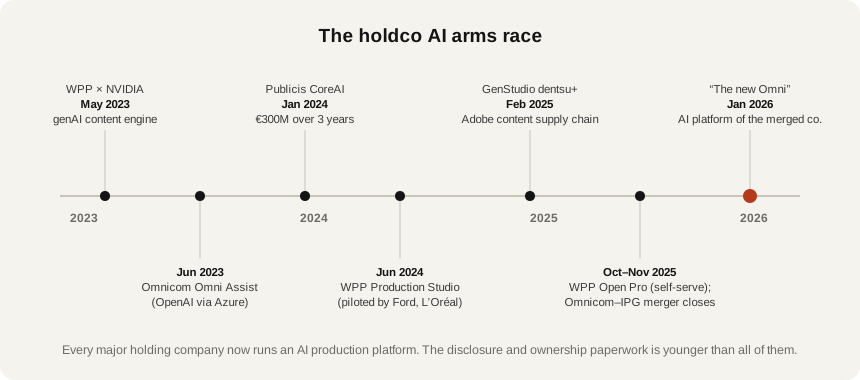
The agency world spent three years and several hundred million euros building AI production capacity. WPP partnered with NVIDIA on a generative content engine in May 2023; Omnicom shipped Omni Assist a month later; Publicis committed €300 million to CoreAI in January 2024; WPP’s Production Studio launched at Cannes 2024 with Ford and L’Oréal piloting. By late 2025 the race had consolidated the industry itself: Omnicom completed its acquisition of IPG in November 2025 and unveiled “the new Omni” six weeks later, while WPP opened its platform to brands directly with Open Pro. The capacity question is settled. The accountability questions are not.
The race, in one timeline
Lay the announcements end to end and the pattern is unmistakable: each holding company now operates an AI layer that generates, adapts and versions creative at industrial scale — dentsu wired Adobe’s GenStudio into its identity stack in February 2025 to the same end. Volume per human reviewer has exploded by design. That is precisely the environment in which the public AI-creative failures we catalogued happen — a lower defect rate multiplied by a much larger volume still ships defects.
Problem one: the client may not own the work
The US Copyright Office settled the core question in its January 2025 report on AI and copyrightability: purely AI-generated output is not protectable, prompts alone do not make a human the author, and no new legislation is needed — existing law suffices. For an agency, that means a deliverable produced end-to-end by a generation platform may be something the client cannot own or enforce as IP: a competitor could run substantially similar imagery with no copyright recourse.
Human authorship in the workflow — selection, arrangement, substantial creative modification — changes the analysis, which is why how much AI was used, and where, is no longer a production detail. It is a fact that determines what the client is buying. Advertising counsel now recommends handling this contractually: written disclosure of AI use in deliverables, explicit liability allocation, and attention to the generation platforms’ own terms of use.
Problem two: disclosure is becoming a duty, not a courtesy
The industry’s own codes moved first: the ANA’s ethics code calls for clear notice of generative AI use in ads where non-disclosure would materially mislead, and the UK’s IPA and ISBA published joint principles for generative AI in creative advertising. Regulation is close behind: from 2 August 2026 the EU AI Act’s deployer duty makes disclosure of realistic AI imagery a legal obligation for whoever publishes it — and the supply chain has started passing rules downstream, the way Adobe Stock already requires contributors to label generative-AI content and bans real-person references in prompts.
For agencies the awkward part is that the duty usually lands on the client — the deployer — while the knowledge of what was AI-generated lives with the agency. That asymmetry is exactly what contracts exist to fix.
What the missing policy looks like
Three clauses and one habit close most of the gap. Clause one: AI-use disclosure per deliverable — what was generated, with which tool, and what was human-modified, recorded at handoff. Clause two: ownership warranty scoped honestly — which parts of the deliverable carry copyright, which are unprotectable AI output. Clause three: liability allocation for defects, IP overlap and disclosure failures. The habit: a verification gate before anything ships — because none of the paper matters if a six-fingered hand or a garbled headline reaches the placement.
The gate is also what makes the disclosure clause true: you cannot honestly certify what was AI-generated, or that it is defect-free, without inspecting the final asset. That inspection is what Chekr automates — per-creative scans with pinned findings, provenance read from the file, and an exportable record. One free scan shows what the per-deliverable record looks like.
What to do about it
- Record AI use per deliverable at handoff — tool, scope, human modification. The copyright status of the work depends on it.
- Do not warrant ownership of purely AI-generated assets; scope the warranty to what is actually protectable.
- Put the disclosure duty in the contract: the client usually owes it legally, the agency holds the facts.
- Verify final assets before delivery — defects, IP proximity, provenance — and keep the record; a scan is the cheapest version of that habit.
- Watch the ANA and IPA/ISBA codes: industry self-regulation is converging on disclosure ahead of the law.
Sources
- WPP partners with NVIDIA to build generative AI-enabled content engine — WPP
- Omni Assist: Omnicom leverages first-mover access to OpenAI — Omnicom
- Publicis Groupe debuts CoreAI platform and €300 million AI investment — Digiday
- WPP unveils AI-powered Production Studio — WPP
- Dentsu pairs Adobe’s generative AI with data identity (GenStudio dentsu+) — Marketing Dive
- WPP unveils WPP Open Pro — WPP
- Omnicom–IPG merger completion (Form 8-K exhibit) — U.S. SEC
- Omnicom unveils the new Omni — Omnicom
- Copyright Office: Copyright and Artificial Intelligence, Part 2 (copyrightability) — U.S. Copyright Office
- Can you protect your AI-generated campaign assets? — BBS Worldwide
- Managing AI copyright risk contractually — Cowan, Liebowitz & Latman
- ANA Ethics Code of Marketing Best Practices — ANA
- Advertising industry principles for the use of generative AI in creative advertising — ISBA / IPA
- Adobe Stock generative AI content rules — Adobe