Shipped without looking: what three years of public AI-creative fails have in common
A third arm in a mayoral platform. Nineteen angry men. “KODAK ROMTOE” on a billboard. The catalogue of AI marketing fails keeps growing — and it is one story, told over and over.
There is now a genre of news story that did not exist three years ago: a brand publishes an AI-generated image, the internet finds the defect within hours, and the brand quietly deletes it. The examples below are all public, reported, and recent — and reading them together reveals something more useful than schadenfreude. The failures cluster into a handful of defect classes, every one of them was visible to a careful human eye before publishing, and in almost every case the audience was the first careful human eye the image ever met.
The catalogue is getting long
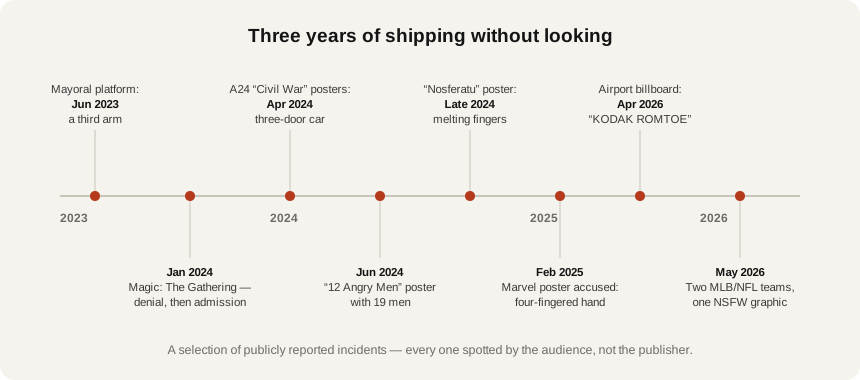
It started as a curiosity. In June 2023, readers of a Toronto mayoral candidate’s platform spotted a woman with a third arm jutting from under her armpit in an illustration — the campaign admitted the AI use and edited the image out. By 2024 the genre had A-list entrants: A24’s posters for Civil War were widely criticized for a three-door car, Chicago’s Marina Towers on the wrong sides of the river, and a giant swan that was probably meant to be a paddleboat. Amazon’s Freevee displayed a poster for 12 Angry Men with nineteen men — smudged faces, missing fingers — before pulling it, and months later Prime Video was mocked again over an AI poster for the 1922 classic Nosferatu, fingers melting into clothing under an impossible moon.
It has not slowed down. In February 2025, Marvel’s Fantastic Four crowd poster was accused of being AI-generated after fans found a hand waving a flag with four fingers and the same woman’s face twice. In April 2026, Manchester Airport said it would remove a giant billboard celebrating photography — on which the AI-generated tourists held cameras branded “KODAK ROMTOE” and “Kobak Pomtoe”. In May 2026 alone: the Arizona Cardinals were savaged for an AI schedule-announcement video, the St. Louis Cardinals posted an AI rivalry graphic that depicted a bear cub in an accidentally NSFW situation, and a Massachusetts House candidate published an AI-processed endorsement photo in which the endorsing senator’s face was unrecognizable and his hand had four fingers.
It is always the same few failures
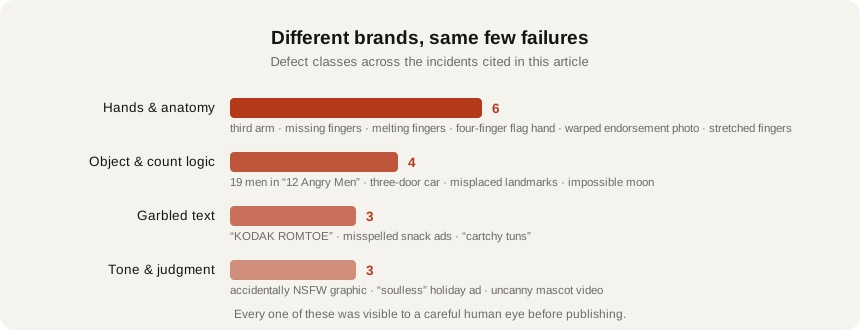
Line the incidents up and the variety disappears. Hands and anatomy lead: the third arm, the missing fingers, the melting fingers, the four-finger flag. Then object-and-count logic: nineteen jurors instead of twelve, a car with three doors, landmarks rearranged, a moon that blocks clouds behind it. Then text: “KODAK ROMTOE”, the misspelled, googly-eyed snack ads that pushed New Jersey brand Chookie back to handmade marketing, and the Glasgow “Willy’s Chocolate Experience”, whose AI website promised “cartchy tuns” and “exarserdray lollipops” before the sparsely decorated warehouse behind it went viral. And finally judgment failures, where nothing is anatomically wrong but everything is: the accidentally lewd bear cub, the uncanny mascot video.
These are, not coincidentally, the exact failure classes AI image models are known for — the same ones Chekr scans as text, anatomy and object physics categories. Generators have improved every year of this timeline, and the incidents have kept coming anyway, because a lower defect rate multiplied by exploding volume still ships defects. The constant is not the model. It is that nobody looked.
The denial trap
The most instructive case is the quietest. On 4 January 2024, Wizards of the Coast posted a Magic: The Gathering marketing image; users flagged AI artifacts; the company replied, flatly, “This art was created by humans and not AI.” Three days later it reversed course: “Well, we made a mistake earlier when we said that a marketing image we posted was not created using AI” — blaming AI components “popping up in industry standard tools like Photoshop” that “crept into our marketing creative”.
That sequence — confident denial, community forensics, forced admission — is strictly worse than either shipping the flawed image or disclosing up front. And the underlying mistake generalizes: you cannot truthfully claim “no AI” about an asset you have not verified, because generative fill and AI upscaling now sit inside the default toolchain. The horror film Late Night with the Devil hit the same wall from the other side: after boycott calls over AI-generated interstitial graphics, the directors confirmed to Variety that AI had been used alongside their graphics team. Provenance is no longer something you assert. It is something you check — which is exactly what Content Credentials exist for, when they survive the pipeline.
Using AI at all is now part of the story
A second pattern in the record: sometimes the defect is beside the point. Levi’s learned this in March 2023, when it announced AI-generated models framed as a diversity initiative and critics called it lazy — hire diverse humans. Coca-Cola’s AI-made remake of its 1995 Christmas ad, produced by three AI studios with four generative models, was called “soulless” and “devoid of any actual creativity” by viewers in November 2024. Whether that sentiment fades or hardens, right now undisclosed or careless AI use is itself a brand-safety variable.
The platforms have noticed. Google Ads holds AI-generated creative to the same policies as everything else and requires disclosure of synthetic content in election ads; Meta requires disclosure for photorealistic AI content in social-issue and political ads; TikTok’s ad rules require AI-generated content in ads to be labeled. And from 2 August 2026, the EU makes disclosure of realistic AI imagery a legal duty — we broke down exactly what the AI Act requires of marketing teams in our previous piece.
The one-minute habit
Here is the strange comfort in this catalogue: not one of these incidents required forensic tooling to prevent. A three-door car, nineteen jurors, a third arm, “KODAK ROMTOE” — each is visible to one attentive person looking at the final asset at full size for one minute. The failures are not model failures; they are process failures. The image went from generator to public with zero careful looks in between.
The honest counter-argument is scale: one minute per asset is easy for a billboard and impossible for four hundred campaign variants. That is the actual problem to solve, and it is why we built Chekr the way we did — every creative gets the careful look automatically, every defect gets pinned to its exact region with a severity, and a human reviews findings instead of hunting for them. Our QA checklist for AI creative describes the process tool-free; if you would rather see it run, scan one of your own creatives — the scan takes about two minutes; the internet finding the finger you missed lasts a lot longer.
What to do about it
- Treat every AI-generated asset as unreviewed until a person (or a tool plus a person) has inspected it at full size — thumbnails hide exactly the defects that go viral.
- Check hands, counts, text and background logic first; the public record says that is where the failures live.
- Never claim “no AI” without verifying — generative features inside standard tools make accidental AI use the default, not the exception.
- Decide your disclosure position before platforms and regulators decide it for you: Google, Meta and TikTok already have rules, and the EU AI Act applies from 2 August 2026.
- Make the review step scale with volume — one free scan shows what an automated careful look catches.
Sources
- Three-armed person mistakenly exposes AI-generated images in Toronto mayoral platform — CTV News Toronto
- A24 criticized for using AI-generated movie posters for “Civil War” — PetaPixel
- Amazon adds frightening AI-generated men to movie poster — PetaPixel
- Amazon mocked for slapping AI-generated poster on beloved 1922 film “Nosferatu” — Futurism
- Wizards of the Coast reverses course, admits to using AI in promotional image — PC Gamer
- Airport says it will remove giant “AI slop” billboard featuring fake photographers — PetaPixel
- AI photo in Massachusetts legislative campaign raises questions — The Boston Globe
- Cardinals’ AI schedule release video draws strong reactions — Pro Football Network
- Cardinals-Cubs series promoted with NSFW AI graphic — Yahoo Sports
- Fantastic Four movie poster AI backlash — Screen Rant
- Brands are learning that people hate AI ads — Futurism
- Glasgow’s “Willy Wonka Experience” unites the internet in laughter — Forbes
- Coca-Cola causes controversy with AI-made ad — NBC News
- “Late Night with the Devil” directors address AI images — Variety
- Levi’s AI-generated models spark controversy — NBC News
- Google Ads: about AI-generated content — Google
- Meta ad standards: ads about social issues, elections or politics — Meta
- TikTok ads policy: misleading and false content — TikTok