“Is it AI?” is the wrong question — what independent tests say about AI-image detectors
Detectors score 98% in the lab, lose half their discriminative power in the wild, and accuse real photos of being fake. The useful question was never whether an image is AI.
There is an entire product category promising to answer one question about an image: did an AI make this? The promise is seductive — paste a URL, get a percentage. But the independent record, from university benchmarks to newsroom tests, tells a consistent story: the percentage is trustworthy exactly when you need it least. And for anyone publishing creative work, it was never the right question to begin with.
The lab numbers are real. So is the collapse.
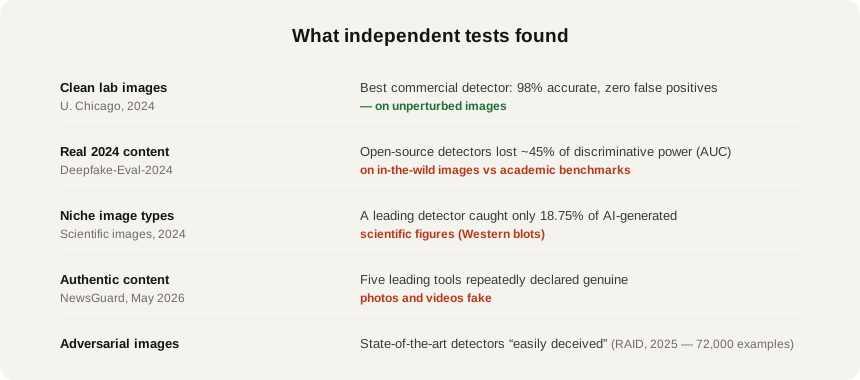
On clean images, good detectors genuinely perform: a University of Chicago study found the best commercial tool, Hive, hitting 98% accuracy with zero false positives on unperturbed images. But move off the bench and the numbers fall apart. Deepfake-Eval-2024, a benchmark of real in-the-wild content from 2024, found open-source detectors losing roughly 45% of their discriminative power (AUC) on images compared with academic datasets. On niche content the collapse is worse: a test on scientific figures found a leading detector catching only 18.75% of AI-generated Western blots.
Journalists found the same thing hands-on: The Washington Post’s interactive test of eight tools on election imagery, and the Reuters Institute’s WITNESS-led review of eight detectors, both concluded the tools fail in exactly the messy, compressed, re-uploaded conditions real content lives in.
The false accusations are the expensive part
A detector that misses an AI image embarrasses you once. A detector that flags a real photo as AI can cost someone a career. In a May 2026 NewsGuard test, five leading tools repeatedly declared authentic images and videos fake. In an earlier hands-on comparison, one tool rated a real photograph as likely AI while others cleared it. Institutions have started acting on this asymmetry — the University of Pittsburgh’s teaching center disabled Turnitin’s AI detector outright, citing false-positive risk.
The vendors know. OpenAI shut down its own AI-text classifier in 2023 over low accuracy, and Google DeepMind says plainly that SynthID “isn’t a silver bullet”.
And it’s an arms race the detector loses
Detection is adversarial by nature. The RAID benchmark released 72,000 adversarial examples and concluded state-of-the-art detectors “can be easily deceived”. Duke’s ImageDetectBench found watermark-based detection consistently beating passive detection — but watermarks have their own proven trade-offs against removal and spoofing. Even the measurement of this race is institutionalized now: NIST runs a standing challenge pitting generators against detectors, round after round. An arms race with a scoreboard is not a foundation for a compliance decision.
This is why the industry’s serious money moved to provenance instead — credentials attached at creation, which have their own survival problem we measured in the previous piece, but at least fail loudly rather than guessing confidently.
The question that actually matters
For a team publishing creative, “is it AI?” is usually already answered — you know, because you made it. The operative questions are the ones a detector cannot touch: is it correct (no garbled text, no broken anatomy, no impossible objects), is it safe (nothing too close to existing work), and is it compliant (disclosure where the law now requires it). That is quality assurance, not detection — inspecting a known asset against concrete failure modes, with findings you can point at.
That reframing is Chekr’s whole design: not a probability that your image is synthetic, but a scan of what is actually wrong with it, pinned to regions, with provenance read from the file. Run one free and compare the output with a detector’s single percentage.
What to do about it
- Never make consequential decisions on a detector score alone — the false-positive record is too costly and the in-the-wild accuracy too weak.
- Expect near-perfect vendor benchmarks and much worse field performance: compression, re-uploads and adversarial pressure are the norm, not the edge case.
- Prefer provenance (Content Credentials, watermarks) over detection where you need origin signals — and verify they survived your pipeline.
- For your own creative, skip the detection question entirely: QA the asset for defects, IP proximity and disclosure instead — one scan answers the questions that carry liability.
Sources
- Organic or Diffused: Can We Distinguish Human Art from AI-generated Images? — University of Chicago (arXiv)
- Deepfake-Eval-2024: a multi-modal in-the-wild benchmark — TrueMedia.org / University of Washington (arXiv)
- AI detectors vs AI-generated scientific images (Western blots) — arXiv
- See how AI detection works, and fails, to catch election deepfakes — The Washington Post
- Spotting deepfakes in the year of elections: how detectors work and where they fail — Reuters Institute / WITNESS
- Leading AI image detection tools mislead users, often declaring authentic content fake — NewsGuard
- AI image detectors accuracy test — MakeUseOf
- University teaching center guidance: AI detection disabled — University of Pittsburgh
- OpenAI scuttles AI-written text detector over low accuracy — TechCrunch
- Watermarking AI-generated text and video with SynthID — Google DeepMind
- RAID: 72,000 adversarial examples against AI-image detectors — arXiv
- ImageDetectBench: passive vs watermark-based detection — Duke University (arXiv)
- Robustness of AI-image watermarks (evasion/spoofing trade-off) — arXiv / ICLR 2024
- NIST GenAI Text-to-Image evaluation challenge — NIST