Every platform labels AI content differently. Here is the 2026 map.
One AI ad, a dozen platforms, a dozen labels and triggers — and most of the automatic ones ride on metadata that does not survive upload. On 2 August, the EU stops leaving it to the platforms.
Make one AI-generated ad and the rules for disclosing it change with every place you post it. Meta may attach an “AI info” label; TikTok wants you to toggle one on; YouTube asks at upload; Google makes you tick a box for election ads; LinkedIn shows an icon only if the file still carries a credential. Some of it is automatic and some of it is on you — and the automatic part mostly depends on metadata that platforms strip. Here is what each major platform actually requires in mid-2026, and why “the platform will label it” is not a compliance plan.
The part you have to do yourself
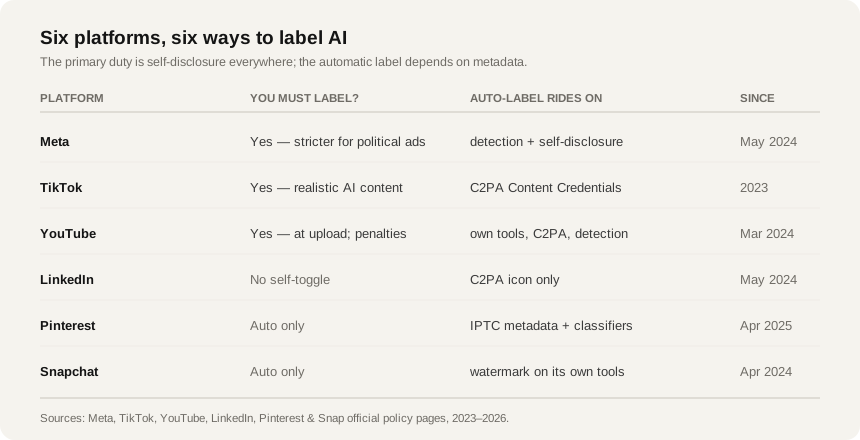
On every major platform the primary obligation is self-disclosure; automated detection is a backstop, not a substitute. Meta adds an “AI Info” label “when we detected industry standard AI image indicators or when people disclosed that they were uploading AI-generated content,” a program it began expanding in May 2024. TikTok requires people to “label AI-generated content that contains realistic images, audio or video,” a rule it reaffirmed in March 2026. YouTube, since March 2024, requires creators to disclose realistic “altered or synthetic” content at upload; photorealistic content gets a label in the player, other content a note in the description.
The rest of the field has each picked its own shape. Pinterest rolled out an “AI modified” label globally on 30 April 2025; Snapchat adds a small ghost-and-sparkle watermark to images made with its own AI tools; and X is still building a post-level toggle to mark “synthetically generated content,” reported still in development as of February 2026. Same intent, six different labels, six different triggers.
Political and issue ads are where it has teeth
General AI labels are mostly informational. The enforceable rules live in political and social-issue advertising. Meta requires advertisers to disclose when a social-issue, election or political ad “contains a photorealistic image or video, or realistic sounding audio, that was created or edited using … generative AI” in three defined cases — depicting a real person doing something they did not do, depicting a realistic person or event that does not exist, or an event that did not happen — and from 1 June 2026 also auto-detects AI-created ads and surfaces them through an “About this ad” tool.
Google Ads requires advertisers to “disclose all election ads that contain synthetic or digitally altered content” via an “Altered or synthetic content” checkbox, then auto-generates the in-ad disclosure for feeds and Shorts on mobile and for in-stream formats — for everything else, the advertiser must add their own “clear and conspicuous” disclosure. And YouTube warns that creators who “consistently choose not to disclose” can face “penalties … including removal of content or suspension from the YouTube Partner Program.” This is the tier where getting it wrong costs money, not just a badge.
The automatic label rides on C2PA — which mostly falls off
The convenient story is that platforms read a credential embedded in the file and label AI content for you. Several do: TikTok was the first video platform to read C2PA Content Credentials, auto-labeling AI content from other tools since 9 May 2024; LinkedIn shows a C2PA icon tracing whether media was “created or edited by AI”; Pinterest reads IPTC metadata plus its own classifiers.
The problem is that the credential usually does not reach the viewer. As we found auditing hundreds of posts, Content Credentials survive the trip to a viewer only about thirty percent of the time — screenshots, re-encoding and upload pipelines strip the metadata. The platforms know it: TikTok is now adding invisible watermarks because metadata alone is not enough, and LinkedIn concedes “it’s not yet possible to identify and label all AI-generated and modified content.” The automatic layer is real but partial. The only label you can count on is the one you apply yourself.
On 2 August, it stops being a platform courtesy
The platform patchwork is about to sit under a legal floor. The EU AI Act’s Article 50 requires providers to mark AI output “in a machine-readable format and detectable as artificially generated or manipulated,” and deployers to “disclose that … content has been artificially generated or manipulated” for deep fakes. Those transparency obligations become applicable on 2 August 2026, and a breach sits in the fine tier of up to €15,000,000 or 3% of worldwide annual turnover, whichever is higher. It lands on the advertiser, not the AI vendor.
The US is arriving from the other direction. The FTC’s 2024 final rule bans AI-generated fake reviews and the sale of bot-generated engagement, and California’s AI Transparency Act (SB 942) requires large generative-AI providers to embed a permanent latent disclosure in AI content, with a “civil penalty in the amount of five thousand dollars ($5,000) per violation.” Add the Nordic layer already in force and a single AI campaign can be regulated several times over.
The through-line is simple: disclosure is moving from platform UI toggle to legal duty, and it lands on whoever publishes. The only way to disclose reliably across a dozen platforms and three legal regimes is to know, per asset, what was AI-generated in the first place — which is a brand-and-provenance check you run before the campaign ships, not a label you hope the platform adds after.
What to do about it
- Treat self-disclosure as the baseline everywhere: Meta, TikTok and YouTube all put the primary duty on the person posting, with automated detection only as a backstop.
- Know the political-ad rules separately — Meta SIEP, Google Ads’ “altered or synthetic content” checkbox and YouTube’s penalties are the tier with real enforcement.
- Do not rely on C2PA auto-labels to travel: Content Credentials reach the viewer only about 30% of the time, and platforms are already bolting on watermarks to compensate.
- Plan for 2 August 2026: EU AI Act Article 50 makes disclosure a legal obligation on the advertiser, backed by fines up to €15M or 3% of turnover.
- Keep a per-asset record of what was AI-generated or AI-edited, so you can disclose consistently no matter where the creative runs. A scan gives you that provenance and brand check before publish.
Sources
- Labeling AI Content | Transparency Center — Meta
- Our Approach to Labeling AI-Generated Content and Manipulated Media — Meta Newsroom
- Ads about Social Issues, Elections or Politics | Transparency Center — Meta
- How Meta Is Preparing for the 2026 US Midterm Elections — Meta Newsroom
- Political content — Advertising Policies Help — Google
- How we’re helping creators disclose altered or synthetic content — YouTube
- Disclosing use of altered or synthetic content — YouTube Help — YouTube
- New labels for disclosing AI-generated content — TikTok Newsroom
- Partnering with our industry to advance AI transparency and literacy — TikTok Newsroom
- TikTok shares more ways to spot, shape and understand AI-generated content — TikTok Newsroom
- Content credentials | LinkedIn Help — LinkedIn
- LinkedIn rolls out C2PA AI-generated content standard — LinkedIn Newsroom
- Introducing Gen AI Labels — Pinterest Newsroom
- Gen AI labels | Pinterest help — Pinterest
- AI on Snapchat: Improved Transparency, Safety, and Policies — Snap Inc.
- X tests AI labeling to combat the rise of generated content — Social Media Today
- Article 50: Transparency Obligations for Providers and Deployers of Certain AI Systems — EU Artificial Intelligence Act
- Code of Practice on Transparency of AI-Generated Content — European Commission
- Article 99: Penalties — EU Artificial Intelligence Act
- FTC Announces Final Rule Banning Fake Reviews and Testimonials — U.S. Federal Trade Commission
- Bill Text — SB-942 California AI Transparency Act — California Legislative Information