The Filippa K case: an AI campaign copied real photographers — and one image search caught it
Three weeks after launch, a photographer put the AI campaign next to the originals. Two days later the whole campaign was gone. The check that would have prevented it takes seconds.
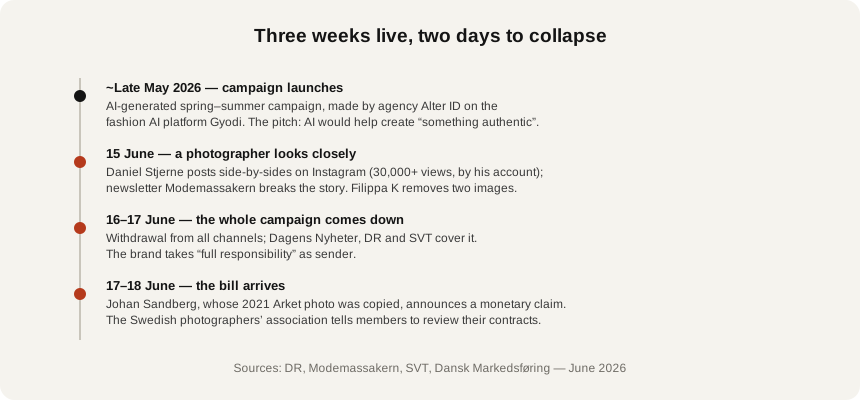
On 15 June 2026, Danish fashion photographer Daniel Stjerne posted side-by-side images on Instagram: frames from Filippa K’s new AI-generated campaign next to existing photographs by working photographers. Two days later the Swedish brand had pulled the entire campaign and taken “full responsibility”. It is the cleanest case study yet of the one risk every team publishing generative imagery carries — and of how absurdly cheap the catch would have been.
Three weeks of “something authentic”
The campaign for Filippa K’s spring–summer collection had been live for about three weeks, per Danish trade outlet Dansk Markedsføring. It was produced by Swedish agency Alter ID on Gyodi — a platform that markets itself as the first end-to-end AI platform for fashion brands, and which Alter ID had joined as a strategic partner in late May. Two weeks before the scandal, Gyodi’s chief told DR that AI would help create “something authentic” in the campaign’s narrative.
Then Stjerne looked closely, posted the comparisons (an Instagram story he says was seen more than 30,000 times), and Swedish fashion newsletter Modemassakern broke the story. At least two campaign images bore a striking resemblance to existing photographs: one to a photo Swedish photographer Johan Sandberg shot for Arket’s 2021 collection, the other to Greek photographer Athina Chrissaki’s “A Day on a Rock” — a man standing on a cliff while a woman dives into the sea. Sandberg recognized his own picture down to the folds of the sweater and the veins on the model’s hand; he told DR he was “pissed”, was talking to his lawyers, and that a monetary claim was on its way.
Filippa K first removed the two images, then took the whole campaign down from every channel. PR chief Amelia Sciard said the company took the matter “very seriously”, accepted full responsibility as the campaign’s sender, and later announced “even stronger guidelines, quality controls and working methods” for AI content. The word that stuck in the industry coverage — “naive” — came from a Danish marketing commentator, and it was the polite version. Photographer Daniel Stjerne’s was “a middle finger to the people who built the brand” (quotes translated from Danish).
The catch cost nothing. The miss cost the campaign.
The most damning detail isn’t that the AI copied — it’s how easy the copying was to find. “It’s incredible that no one caught it,” Stjerne told DR: a Google image search surfaced the matches. Nobody in the chain — agency, platform, brand — ran that search before publishing. A Swedish AI-industry commentator’s conclusion was that generation tools should build pre-publication similarity checks into the pipeline itself.
That check exists. We ran the diving image at the center of the case through Chekr’s similarity check: the reverse-image search returned a 97% match to an existing online image in seconds and flagged the creative for IP review before publication. That is the entire QA step Filippa K’s campaign never got — one scan per hero image, free to try.
Why the machine copied
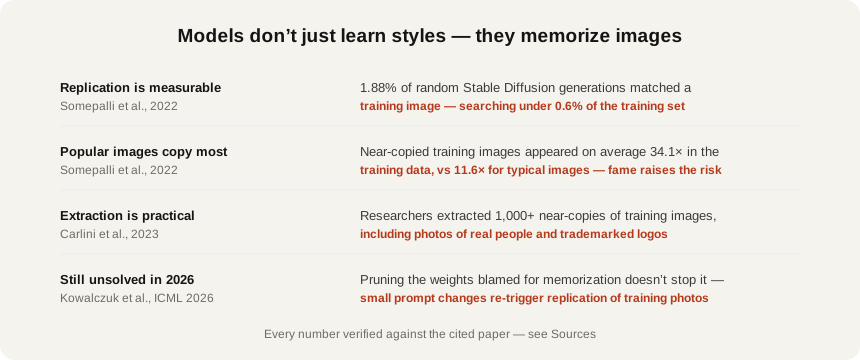
Filippa K offered no explanation of how its AI produced two near-copies. The research literature has one, and it isn’t “bad luck”. Diffusion models memorize training images: Carlini et al. extracted more than a thousand near-copies of training examples from state-of-the-art models, including photographs of real people. Somepalli et al. found that about 1.88% of random Stable Diffusion generations matched a training image at high similarity — likely an undercount, since they searched under 0.6% of the training set — and that the images most likely to be regurgitated are the ones duplicated most across the training data: 34.1 copies on average, versus 11.6 for typical images. Editorial fashion photography that gets reblogged for years is exactly that kind of image.
The problem is not solved, and current mitigation does not remove it: 2026 research shows that even after pruning the model weights blamed for memorization, small changes to a prompt re-trigger replication of training photos. And industry commentary on this case points at a second, more mundane mechanism: agencies feeding reference photos directly into generation. Danish ex-advertising executive Peter Stenbæk’s summary in Euroman: “If you don’t do your groundwork well enough, your AI just makes a copy of something else.” Whichever mechanism produced these two images, the lesson is the same: you cannot audit the model, so you have to audit the output.
The brand pays — twice
Legally, the exposure lands on whoever publishes. Under EU copyright law the question is the reproduction right: per the Court of Justice’s Infopaq standard, even partial reproduction infringes when the copied elements express the author’s own intellectual creation — and the user who generated and published the output can be primarily liable, regardless of intent. Filippa K calling itself “responsible as sender” wasn’t just PR language; it’s roughly where the law puts it. The agency-brand liability question is then a contract fight after the fact — which is why the Swedish photographers’ association immediately told its members to review their AI contract terms.
The second cost is stranger: the brand never owned the campaign it was defending. Purely AI-generated images are not copyrightable — the US Copyright Office settled its position in January 2025, the D.C. Circuit affirmed the human-authorship requirement in Thaler v. Perlmutter and the Supreme Court declined to revisit it in March 2026, and the European Parliament’s research service confirms the EU position mirrors it782585). Publish a fully generated campaign and you carry infringement risk on an asset you cannot protect.
And Filippa K is not an outlier — it is the pattern. The same month, model Francheska Pujols sued US retailer Rainbow Shops over AI-generated images of her she never posed for (withdrawn for settlement talks, then refiled when they failed). Before that: Wacom’s deleted AI dragon campaign, Under Armour’s “AI-powered” ad accused of repackaging another director’s footage, Shopify pulling an AI likeness of a cookbook author. The pattern is the one we documented in our roundup of AI creative failures: the work ships, the internet does the QA, the brand does the apology.
What to do about it
- Reverse-image search every AI-generated hero image before it ships. The Filippa K catch was one Google search — done by the wrong person, three weeks too late.
- Treat well-known editorial photography as high-risk prompt/reference input: the most-duplicated training images are the most likely to be regurgitated (34.1× vs 11.6× average duplication).
- Put output-similarity checks and indemnification into agency and platform contracts before the campaign, not after — liability lands on the sender.
- Remember you cannot own what the model made: pure AI output is unprotectable in both the US and EU, so you carry the risk without keeping the asset.
- Automate the check where volume is high: one scan returns a similarity score and closest match per creative in seconds.
Sources
- Svensk modegigant dropper kampagne efter kopi-anklager — DR
- Dansk modefotograf så sine kollegers arbejde misbrugt af kunstig intelligens — DR
- Svensk modefotograf er ”pissed” efter plagiatsag — DR
- BREAKING: Filippa K anklagas för plagiat — Modemassakern
- Svensk modebrand trak heftigt kritiseret AI-kampagne: ”Naivt” — Dansk Markedsføring
- Kan du se forskel? Stort modefirma har lavet en AI-kampagne. Og folk er rasende — Euroman
- Sveriges Fotografers Förbund uppmanar sina medlemmar att se över sina avtal — SVT Nyheter
- Filippa K:s AI-bilder anklagas för att efterlikna fotografernas verk — Fotosidan
- AI-ekspert om Filippa K-plagiatet: Varemærkers mangel på retning er problemet — Ehandel.dk
- Alter ID joins AI platform GYODI as fashion brands rethink content production — Scandinavian MIND
- A Day On A Rock — Athina Chrissaki
- Extracting Training Data from Diffusion Models — Carlini et al. (arXiv)
- Diffusion Art or Digital Forgery? Investigating Data Replication in Diffusion Models — Somepalli et al. (arXiv)
- Finding DoRI: Discovery of Retained Images in Diffusion Models — Kowalczuk et al. (ICML 2026, arXiv)
- AI didn’t plagiarize that campaign. A reference photo did. — Aavi Studio (industry commentary)
- Copyright Infringements in Output of Generative AI: Who is liable? — Kluwer Copyright Blog
- Infringing AI: Liability for AI-Generated Outputs under International, EU, and UK Copyright Law — European Journal of Risk Regulation
- Copyright Office Releases Part 2 of Artificial Intelligence Report — U.S. Copyright Office
- Supreme Court Denies Cert in AI Authorship Case — Mayer Brown
- Copyright of AI-generated works: Approaches in the EU and beyond — European Parliamentary Research Service
- Model Sues Fashion Brand After it AI-Generated Pictures of Her — PetaPixel
- A Fashion Model Is Again Suing Rainbow Shops Over Unsanctioned AI Images — Sourcing Journal (via Yahoo)